

fictions
The Margin Scribe
french version
Sému dipped his reed pen in the ink of the Tagus. That was what they called the mixture of lampblack and muddy water that the preparers drew from the river before dawn, when the silt still carried sediments from before the Erasure. The ink smelled of earth and metal. Some copyists claimed to detect a third scent, older, that they couldn't name.
Light had not yet reached his desk. Between the white columns of the synagogue, the air was cold and the silence so dense you could hear the scrape of reed pens on neighboring lecterns before the day revealed them. Santa María la Blanca had never been a scriptorium. It had been a synagogue, then a church, then ruin, then refuge. Now it was where the remnants of the world were copied. The horseshoe arches repeated their curve from column to column like a sentence searching for itself, never finding its period.
Beside his inkwell, a splinter of wood no larger than a palm. Someone had painted a face on it, long ago. Someone else had tried to scratch it away. The face remained. Neither fully present nor fully erased.
Sému placed his pen at the edge of the source text. A fragment of Kafka—or of what was believed to be Kafka. No one knew for sure anymore. The printed paper crumbled at the folds, and entire lines had vanished, taking pieces of sentences with them the way a river takes its banks. It described a machine that engraved words into human skin. Sému possessed neither the beginning nor the end. Only the middle—the apparatus, the moment the needle pierced, the condemned man deciphering his sentence with his body.
Each morning, Sému felt as though he were carrying water in his hands.
He began to trace.
The first word came without effort. The second, too. His hand knew. It had learned not to hesitate, to flow into the furrow of letters like the Tagus into its gorges. Sému loved this moment when thought receded and the body worked alone—the wrist, the breath, the rhythm of the reed on taut skin. He disappeared. He became passage.
It was in the middle of the third line that he saw it.
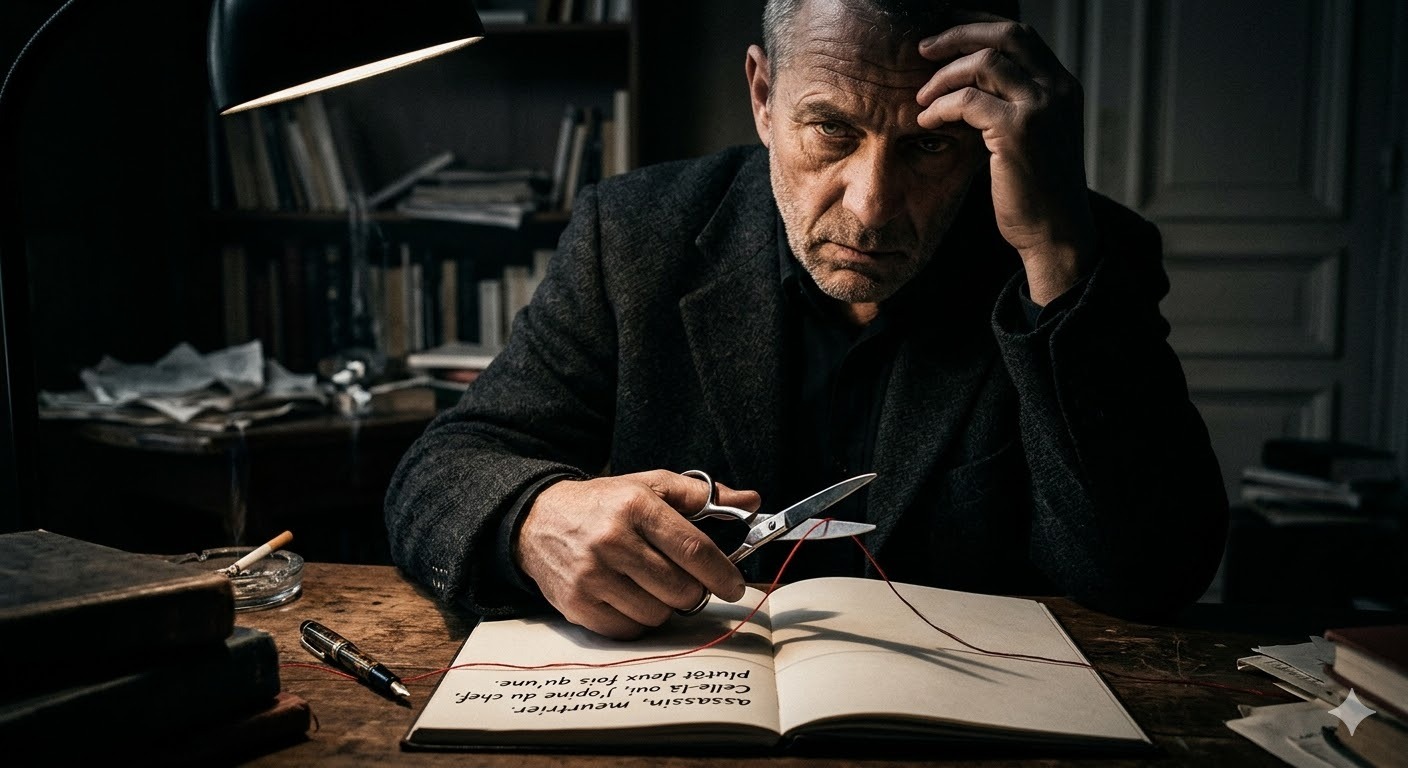
In the margin of the page he had copied the day before, a mark. Three thin strokes, slightly curved, corresponding to no letter in the alphabet he used. The ink was the same. The thickness of the stroke was the same. It was his handwriting.
But they were not his words.
He scratched the mark with his nail. The ink resisted, as if it had had time to sink deeper than the other letters. He scratched harder. The parchment frayed, but the mark remained, a pale ghost beneath the scraped surface.
Sému looked around him. The copyists worked, heads bowed, in the oblique light beginning to descend from the high windows. No one looked up. The rule of the scriptorium was simple : each to his own desk, each to his own text, each to his own silence. You did not look at another's work. You did not comment. You copied.
He returned to his Kafka. The machine engraved its sentence into the condemned man's flesh. Sému traced the words one by one, but something had shifted. His hand faltered. As if the reed were seeking the margins, drawn to the edges of the page by a horizontal pull he did not understand.
At noon, the bell rang. The copyists set down their pens. Sému did not move. He waited until the hall emptied, then rose and did what he had never done : he went to look at the others' desks.
The first—Dara's, a silent woman copying fragments of medical texts—was immaculate. Blank margins. No stray marks.
The second—that of a young copyist whose name he did not know—likewise. Clean.
The third desk belonged to Itzak, an old man who had worked at the scriptorium since its founding. He was copying a treatise on astronomy, two-thirds of it missing. Sému leaned over the previous day's pages.
In the margin of the third sheet, a mark. Not the same as his own. More angular, tighter. But traced with the same ink of the Tagus, the same thickness. And plainly, the mark bore the same involuntary character—it did not extend any word, corrected nothing, annotated nothing. It was there like a stone in the middle of a path.
Sému felt cold rise from his feet to the nape of his neck.
He returned to his desk. He took the day's page and Itzak's, laid them side by side. His mark on the left. Itzak's on the right. Two different marks. But when he looked at them together, letting his eyes soften as if regarding a distant landscape, the two marks seemed to orient toward each other. Like two halves of a word cut in two.
He heard a step behind him and slid Itzak's page back into place. Too quickly. The parchment slipped and fell. When he picked it up, his fingers touched the ink of the marginal mark.
It was warm.
That evening, Sému walked home through the alleys of the eastern quarter. The path sloped between walls of ocher stone where ivy vied with dead cables. Children played with polished shards of glass they called eyes—the remains of broken screens, worn smooth and opaque as river stones by the Tagus. They traded them by color. Blue was worth more. No one knew why.
Their apartment occupied two rooms above an old garage whose iron shutter had been melted down for tools. Mara sat by the window, a sewing basket on her lap. She had been mending the same trousers for three days. Or perhaps she was mending nothing. Perhaps she watched the street, holding a needle to give herself countenance.
Sému set down his bag.
"The roof leaked again last night," Mara said, not looking up.
"I'll see to it tomorrow."
"You said that last week."
He didn't answer. He sat on the stool by the door. Between them, the table. On the table, bread, a bowl of oil, two chipped plates. The space between the two plates was the exact territory of what they no longer said to each other.
He wanted to tell her about the marks in the margins. The words rose to his throat and stopped there, like water in a siphon. How do you explain to someone wrestling with a leaking roof that your hand writes things you haven't thought ? That the ink was warm beneath your fingers ? That two marks separated by three desks reached for each other like halves of a word ?
Mara mended. Sému ate. The silence between them was not the silence of the scriptorium—dense, fertile, full of reed pens. It was a dry silence. A silence of a roof that leaks and is not repaired.
That night, Sému did not sleep. He thought of the marks. He thought of Kafka's machine engraving words into flesh. He thought of what old Master Itzak had said to him one day, months earlier, in passing, as one says something unimportant :
Letters are not signs, Sému. They are scars. Someone cried out, long ago. The cry left a mark. We call it Aleph.
Sému turned toward Mara. She slept, her back to him. Her breathing was slow and steady. On the nape of her neck, a strand of black hair formed a curve that resembled—he blinked—resembled what ? Nothing. A strand of hair on a nape. Not everything was a sign. Not everything was margin.
Or perhaps it was.
The next day, there were three new marks in his margins. And five in Itzak's. And two—this was new—in Dara's.
Sému did not scrape them away.
Esdras came on a Tuesday.
No one had announced him. He entered through the southern door, the one no one had used since the lintel cracked. He pushed it open as if he knew the building better than those who worked there daily. Perhaps he did. It was said Esdras had helped found the scriptorium thirty years earlier, when the first survivors understood they must save the texts or lose the world's memory. It was also said he had left Toledo to travel to other scriptoria—Lisbon, Lyon, Tübingen—and that he returned when something was wrong.
He wore a coat of tanned leather, worn at the elbows but clean. His hands were large, his fingers long and stained with ancient ink, embedded in the skin like unintended tattoos. A former copyist. His eyes were the detail you remembered : clear, very clear, a gray that seemed bleached by decades of reading.
He crossed the hall without looking at anyone. The copyists felt his passage as one feels a shift in air pressure. Reed pens faltered for a second on parchment, then resumed.
Esdras stopped before Itzak's desk. The old man raised his head. Something passed between them—not a word, not a greeting, something older. Esdras took the day's page. He studied it at length. Then he turned it over and examined the margins.
His face did not change. But his fingers tightened on the edge of the parchment.
He set the page down and continued his walk. Desk after desk. He did not look at the copied texts. He looked at the margins.
When he reached Sému, he did not take the page. He stood, silent, his eyes fixed on the splinter of wood beside the inkwell. The half-scraped face.
"Where did you find that ?"
His voice was low, precise, neither warm nor cold. A reed pen's voice.
"In the rubble of the eastern quarter."
"Do you know what it is ?"
"A piece of painted wood."
Esdras gave a brief smile. Not a mocking smile. A smile of recognition—like a chess player seeing an opponent open with an unexpected move.
"It is a face someone tried to erase. And that remained. You find that beautiful, don't you."
It was not a question. Sému did not answer. Esdras took the previous day's page. He raised it to his bleached eyes. He looked at the margin. The mark. The three curved strokes Sému had not traced—or had traced without willing it.
"How long ?"
"A week. Perhaps more. I don't know."
"You don't know, or you didn't want to see ?"
He set the page down.
"Come see me this evening. After the bell. I will be in the cistern."
He moved away. Sému looked at his hands. The ink dried on his fingers. For the first time, he noticed the stains formed a pattern he had not chosen.
The cistern was the belly of the scriptorium. A water reservoir built by the Arabs a thousand years before, emptied by centuries, converted into a strongroom for source texts. The air was cool and still. Salvaged iron shelves lined the brick walls. On each shelf, stacks of printed paper, notebooks, fragments hastily bound with twine and leather. What remained of the world's library.
Esdras sat at a stone table in the center of the room. Before him, a dozen pages spread in a fan. Sému recognized his own. And Itzak's. And Dara's.
"Sit."
Sému sat. The oil lamp cast their shadows on the walls. Esdras's shadow was larger than him. Sému's trembled.
"Look," said Esdras.
He arranged the pages in a precise order. The margins faced one another. The involuntary marks of Sému, those of Itzak, those of Dara, aligned side by side.
Sému saw what he had sensed without daring to articulate. The marks did not merely answer each other. They formed a sequence. A mark of Sému's called to Itzak's, which called to Dara's, which referred back to another mark of Sému's. A circular sentence, written by three hands that had not concerted.
"Do you see ?" said Esdras.
"Yes."
"Do you know what it is ?"
"No."
"I do."
Esdras rose. He retrieved a page from a shelf at the far end. Very old. The paper was yellow and brittle. Mechanical printing, from before the Erasure.
"This text was found in Lyon twelve years ago. A fragment of a linguistic study. The author sought to demonstrate that handwriting produces neuromotor residues—micro-movements of the hand that escape conscious control and leave traces in the margins, between lines, beneath letters. Traces invisible to the naked eye in a single text, but visible when you compare dozens of pages copied by different hands."
He placed the page on the table.
"The author called it the involuntary graphosphere. A layer of subterranean language, produced by the bodies of copyists without their knowledge. Like a collective dream printed in ink."
Sému looked at the aligned margins. The circular sentence of the three copyists. The collective dream.
"It's beautiful," he said.
"It's dangerous," said Esdras.
The word fell into the silence of the cistern like a stone into a well.
"Dangerous ?"
Esdras sat again. He clasped his hands—those large hands stained with ancient ink—and spoke slowly, like a man who has long considered what he is about to say.
"Sému, I founded this scriptorium. I traveled through six countries to understand how to save what could be saved. I saw entire libraries reduced to three pages. I saw copyists driven mad by copying texts they did not understand. I saw the Erasure up close—not as you did, who were born after, but close, with the smell of burning servers and the silence falling over cities like snow. And do you know what I understood ?"
"No."
"That the Erasure was no accident. Language itself had saturated. Too many words. Too much noise. Too many texts saying everything and its opposite. Machines amplified the chaos—they generated billions of sentences per second, grammatically correct and semantically hollow, and no one could distinguish signal from noise. The world drowned in its own language. The Erasure was a drowning."
He gestured at the margins.
"And this is the beginning of a new drowning. These involuntary marks, this graphosphere, these unconscious residues—it is the same process. Uncontrolled language proliferating. The margin invading the text. Noise drowning signal. If we let it happen, in ten years the margins will have devoured the pages. Copyists will no longer know what they wrote deliberately from what their hand added without them. The Kafka you copy will be contaminated by sentences Kafka never wrote. And no one will know what is Kafka's and what is the dream of your fingers."
He paused.
"I came to scrape the margins, Sému. All of them. On every page. And henceforth, each copyist will be inspected at the end of the day. The margins must be blank. It is the only way to preserve what remains of the signal."
Sému was silent for a long moment. The lamp flame wavered. On the wall, his shadow and Esdras's overlapped at times, like two letters forming a ligature.
"You may be right," said Sému. "Margins are noise. The unconscious is chaos. But tell me this, Esdras. The Kafka I am copying—the one about a machine that engraves words into men's skin—that text, when Kafka wrote it, did he know exactly what he was doing ? Was every word controlled, calculated, deliberate ?"
"Kafka was a writer. Not a copyist. It is not the same."
"Is it not ? Is a writer not someone whose hand moves faster than thought ? Whose fingers find words the mind did not foresee ? If you scrape the margins, Esdras, you scrape the very process that produced the text you claim to protect. Kafka is made of margins. Every living text is made of margins."
Esdras regarded him. His bleached eyes did not blink.
"A pretty argument, Sému. But it is the argument of a scribe, not a guardian. My work is not to understand language. My work is to transmit it intact. And intact means without addition, without parasite, without dream. Dream is a luxury we can no longer afford."
He stood.
"Tomorrow morning, I begin with your pages."
He left. Sému remained alone in the cistern, surrounded by what remained of the world's library. He picked up the page where the three margins formed their circular sentence. He looked at it a long time. Then he did something he had never done. He read the margin aloud.
The sound of his own voice in the empty cistern startled him. The words belonged to no language he knew. But they had a rhythm. A cadence. Like a heart beating inside a wall.
The scraping began the next day at dawn.
Esdras worked himself. He did not delegate. He had brought his own tools—a curved-blade scraper, very fine, of the type used by bookbinders before the Erasure. He sat at Sému's desk and took the first page.
The copyists watched in silence. No one protested. No one ever protests when authority is exercised with competence and calm. And Esdras was calm. His gestures were precise. The blade slid across the parchment and the marginal marks vanished under a fine dust of ink that settled on the table like ash.
Sému watched from the southern entrance. His hands were in his pockets. In his right pocket, the page with the three circular margins. He had taken it from the cistern during the night. The one page Esdras would not find.
Esdras scraped the second page. Then the third. Each time, the mark resisted for an instant—the blade had to pass twice, three times—then yielded. A hard, clean circle of white where the mark had been. Mute.
At the fifth page, Esdras stopped.
His right hand trembled.
Not much. A barely visible tremor, a vibration of the wrist that only a copyist would notice. Sému noticed it.
Esdras looked at his hand as one looks at a tool that malfunctions. He set down the scraper. He flexed his fingers. Picked up the scraper again. Continued.
At the eighth page, the tremor had reached his forearm.
At the twelfth, Esdras set down the scraper and rose. He went to wash his hands in the stone basin near the entrance. The water reddened slightly—the ink of the Tagus, dissolving, returned to its river color. He returned, hands wet, and resumed.
At the fifteenth page, Sému saw something no one else saw.
On the sixteenth page—the one Esdras had not yet touched—a new mark had just appeared in the margin. The ink was fresh. It gleamed in the oblique light.
It was not Sému's handwriting. Nor Itzak's. Nor Dara's.
It was Esdras's.
Esdras took the sixteenth page. He saw the mark. He recognized his own hand. His face did not change—he had too much composure for that—but his bleached eyes fixed on the margin with an intensity Sému had never seen. The intensity of a man looking at a crack in the wall of his own house.
He scraped the mark. His own marginal trace. His own involuntary mark. The blade passed once, twice, three times. The mark paled but did not entirely disappear. A shadow remained, like the face on the splinter of wood.
Esdras set down the scraper. He remained motionless for a long time. The whole hall held its breath without knowing it.
Then he did something unexpected. He took Sému's reed pen, dipped it in the ink of the Tagus, and brought the point to the margin. His hand still trembled. He traced nothing. He held the pen suspended above the parchment, a hair's breadth from the surface, for what seemed an eternity. The ink formed a drop at the tip. The drop swelled. It fell.
It fell into the margin and drew, in its fall, a shape no one had decided. Neither Esdras. Nor Sému. Neither the hand. Nor the thought. A shape born of gravity and the ink of the Tagus and the tremor of a man who had just understood that language obeys no one.
Esdras looked at the blot. Sému saw his lips move. He spoke no audible word. But Sému, who had spent his life reading signs, read on his lips a sentence he understood only much later :
I am the margin.
Esdras rose. He left the scraper on the desk. He crossed the hall without looking at anyone and exited through the southern door, the one with the cracked lintel, the one through which he had entered. He did not close it.
The light from outside entered the scriptorium like an unfinished sentence.
Sému did not follow him. He remained standing between the white columns. The copyists, one by one, took up their reed pens. The sound returned—the soft friction of ink on parchment, the breath of bodies at work. Itzak did not raise his head. Nor did Dara. The scriptorium continued. It would continue.
Sému sat at his desk. The page with the three circular margins was still in his pocket. He took it out and placed it beside the Kafka. The machine engraved words into the condemned man's skin. The margins engraved words into the skin of the text. The condemned man ended by reading his sentence with his body. Sému ended by reading the margins with his hands.
He dipped the reed and resumed copying. His hand did not tremble. It did not falter. But in the margins, he knew, something would continue to write itself—something older than him, older than Kafka, older than the white columns of the synagogue. A cry become scar become letter become cry once more.
That evening, he did not take his usual path. Instead of descending through the alleys of the eastern quarter, he followed the Tagus. The river was low. On the bank, hard drives polished by the current gleamed like black pebbles in the fading light. A child gathered them, stacked them, built a tower that would not stand. It fell. He rebuilt it. It fell. He rebuilt it.
Sému stopped before the bridge of San Martín. The arches spanned the Tagus like letters spanning the void between words. He thought of Esdras. Of his trembling hand. Of the drop of ink falling into the margin. Of those three silent words : I am the margin. If even Esdras—the guardian, the scraper, the purifier—was traversed by the involuntary, then no one was exempt. Language did not ask permission. It passed. Through the hands of copyists, through the dreams of sleepers, through ink stains and cracks in walls and strands of hair on the nape of sleeping women.
He went home.
Mara was at the window. The same sewing basket. The same needle. The roof had leaked again—a dark patch spread beneath the table, between the two chipped plates.
Sému sat across from her.
Usually, he ate in silence, thought of the scriptorium, and fell asleep with letters behind his eyelids. Usually, the space between the two plates was a dead margin.
That evening, he said :
"Mara."
She looked up. He searched for words. They did not come. Not the words of the scriptorium, not scholarly language, not the diction of the cistern and ancient texts. Those were useless here. He sought other words—smaller, more ordinary, more damaged. Words with leaks, like the roof.
"I don't know how to fix the roof," he said. "I don't know how to fix much. But something is happening at the scriptorium. Something I don't understand. My hand writes things I didn't decide. And I think—I think it matters. I think language is trying to say something through us. Something larger. But I don't know what."
Mara looked at him. In her eyes, something stirred. Not understanding—he was not asking her to understand. Something simpler. Presence. The gentle astonishment of someone hearing a voice they had forgotten.
"Go on," she said.
That was all. One word. But that word opened between them a space Sému had not felt in years. Not the dead space between the two plates. A living space. A habitable margin.
He spoke. At length. Poorly. Correcting himself, hesitating, seeking imperfect images for things that had no name. She listened. She did not understand everything. She was not meant to understand everything. But she was there, and her eyes did not leave his, and at times she asked a short question—how do you know ? or does it frighten you ?—and these questions were like the marks in the margins : small, lateral, involuntarily right.
When he fell silent, the patch beneath the table had dried. Or perhaps not. He did not check.
Mara rose. She placed her hand on the nape of Sému's neck—the strand of black hair brushed her fingers—and said :
"Tomorrow, show me."
The next day, Sému arrived at the scriptorium before dawn. He lit the lamp on his desk. The light touched the white columns and the horseshoe arches and the stacked pages and the small splinter of wood with its half-scraped face.
Esdras's scraper was still on the desk, where he had left it. The curved blade gleamed. Beside it, the scraped pages—margins rendered virgin, white, silent. And the pages he had not had time to scrape—margins still inhabited.
Sému took a blank page. He placed it beside the Kafka. He dipped the reed in the ink of the Tagus.
And he did not copy.
For the first time, he wrote.
Not in the text. In the margin. Deliberately. In full awareness. One mark, then another. Not words—not yet. Forms. Curves that resembled the arches of the synagogue, the loops of the Tagus, the strand of hair on Mara's nape. Forms halfway between involuntary and willed, between cry and scar, between sound and letter.
He did not know what he was writing. But he knew that someone, one day, would read it. As he had read the margins of Itzak and Dara. As someone, a thousand years ago, had painted a face on a splinter of wood knowing another would try to erase it and a third would find it in the rubble and place it on his desk beside his inkwell.
Light rose. The copyists arrived one by one. Itzak sat. Dara sat. The scriptorium resumed its breath.
On the final page of the Kafka—the one that stopped mid-sentence because the following pages had been lost in the Erasure—an annotation appeared in the margin. Sému had not written it. No copyist had written it. The ink was warm.
It was a word. One word. In a language Sému did not know but recognized, as one recognizes a face seen in a dream.
He did not scrape it away.
Outside, the Tagus flowed between its stone gorges. A child stacked hard drives on the bank. The tower held. Not long. But it held.|couper{180}
fictions brèves
vitrine éditeur